Congrats on being referred to CourseCareers! Find your next career path now with no upfront cost.

100% Scholarships Available. Open to Everyone.
Learn More

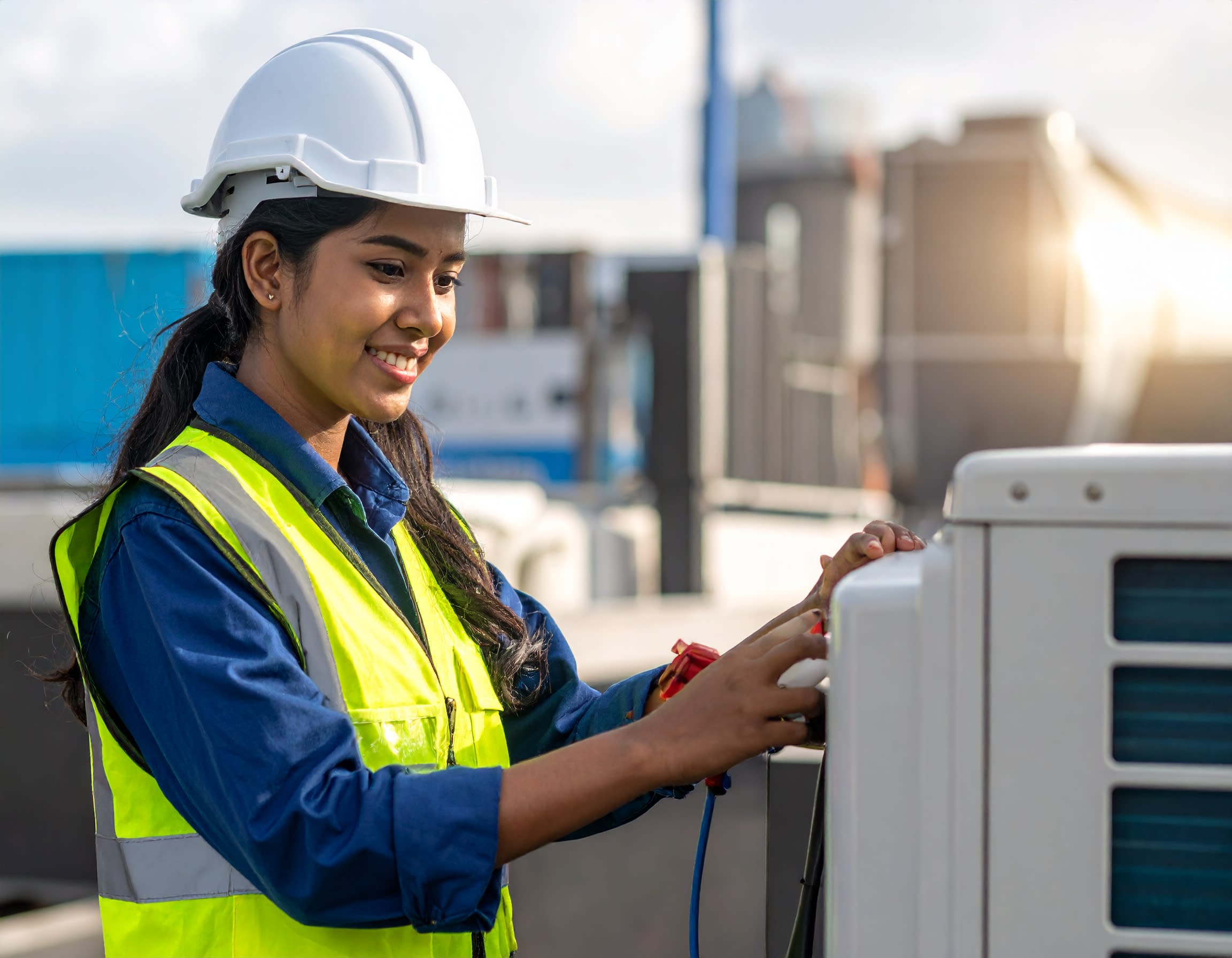


HVAC and electrical work are both growing trades with similar pay: electricians earned a median of $63,190 in 2025, and HVAC techs earned $61,010. The bigger differences are training and daily work. Electricians often serve an apprenticeship of about four years, while HVAC's key federal credential, EPA 608, comes from passing a test and never expires.
For most career changers, our pick is HVAC, and the way in we recommend is the CourseCareers HVAC course. It's our course, so we're biased, but it teaches HVAC theory, HVAC electrical, and service and installation procedures in about 4 to 8 weeks at your own pace. If you're leaning toward electrical work instead, we also offer a CourseCareers Electrician course.
Already set on HVAC? Skip to our step-by-step plan for how to become an HVAC technician with no experience.
Key takeaways
Our pick: get job-ready for HVAC with CourseCareers
If HVAC sounds like your trade, our self-paced course teaches HVAC theory, electrical, service and installation procedures, and the job search. Instructor Tim De Stasio worked 12 years in the trade, then ran his own HVAC company for 10. Try the free intro course first. The full course is $499 or four payments of $150, takes about 4 to 8 weeks, and has a 14-day refund window.
Try the free HVAC intro courseWhat's on this page
Electricians earn slightly more, and by our math their field is almost twice as large. HVAC has fewer formal hurdles, with one key federal certification instead of a multi-year license track.
| HVAC technician | Electrician | |
|---|---|---|
| What they work on | Heating, cooling, ventilation, and refrigeration equipment | Electrical wiring, equipment, and fixtures |
| Median pay (2025) | $61,010 a year ($29.33 an hour) | $63,190 a year ($30.38 an hour) |
| Pay range (2025) | Lowest 10% under $40,050; highest 10% over $95,210 | Lowest 10% at $42,640 or less; highest 10% at $108,510 or more |
| Jobs (2024) | 425,200 | 818,700 |
| Job outlook (2024 to 2034) | Much faster than average (7% or higher) | Much faster than average (7% or higher) |
| Typical training | Certificate program (6 months to 2 years) or apprenticeship, plus on-the-job training | Apprenticeship of about four years: at least 8,000 hours on the job and 576 classroom hours (IEC) |
| Key credential | EPA Section 608 to handle refrigerant; some states and cities add licensing | State or local electrician license, often after an apprenticeship and an exam |
| Top industry (O*NET) | Construction; BLS says 68% work for plumbing, heating, and air-conditioning contractors | Construction |
Sources: O*NET 49-9021.00 and O*NET 47-2111.00 (BLS 2025 wage data, 2024 employment, 2024 to 2034 projections), O*NET wage detail, the BLS Occupational Outlook Handbook (HVAC pay range and training), EPA, and Independent Electrical Contractors. Jobs and outlook use the same years for both trades.
Electricians earn a bit more, and the gap grows at the top of the pay scale. Both trades are growing faster than most jobs, so neither is a bad bet on demand.
Electricians earned a median of $63,190 a year in 2025, according to BLS wage data published on O*NET. HVAC techs earned a median of $61,010 in May 2025 (BLS). By our math, that's a difference of about $2,200 a year, or roughly $1 an hour.
The spread is wider among top earners. The highest-paid 10% of electricians made $108,510 or more, while the top 10% of HVAC techs made more than $95,210 (O*NET, BLS). Beginners in both trades usually start toward the low end.
Both trades pay you while you learn. IEC says electrical apprentices typically start at about half of a journeyman's rate, with raises as their skills grow. HVAC helpers and apprentices also earn from day one.
For 2024 to 2034, O*NET rates both trades as growing much faster than average, and electricians are the larger field: 818,700 jobs in 2024, compared with 425,200 HVAC jobs. BLS's newer HVAC projection covers a different period, 2025 to 2035, and calls for 11% growth with about 40,600 openings a year.
If you're worried about long-term demand for heating and cooling work, Is HVAC a Dying Trade? walks through what the job data shows.
Becoming a fully qualified electrician usually takes longer. Electricians typically serve an apprenticeship of about four years and often must pass a licensing exam. HVAC techs can prepare for entry-level jobs in months, and the one federal requirement is EPA 608 certification.
Many HVAC techs take a trade school or community college program, which BLS says lasts 6 months to 2 years (BLS). Others train through an apprenticeship, or prepare on their own and start as a helper. Compare the routes in the best HVAC training paths for beginners.
To work on equipment that can release refrigerant, you need EPA Section 608 certification. You earn it by passing an EPA-approved test, and it never expires (EPA). Registered apprentices are the one exception: they may work uncertified for up to two years under close supervision (40 CFR 82.152). Some states and cities also license HVAC work. See EPA 608 certification and how it compares to NATE for how the credentials fit together.
Our recommendation: if you go the HVAC route, learn the fundamentals with the CourseCareers HVAC course, get EPA 608 certified, then apply to local contractors.
Many electricians learn through an apprenticeship that mixes paid work with classroom study. Independent Electrical Contractors, a trade group with a Department of Labor-recognized apprenticeship program, says one typically takes about four years. It includes at least 8,000 hours of on-the-job training and 576 hours of classroom instruction.
In O*NET's survey, 62% of electricians said a new hire needs a postsecondary certificate.
Licensing is set by states and sometimes cities. Texas licenses both trades through one agency, the Texas Department of Licensing and Regulation (TDLR), which makes a handy comparison. Your state may differ.
| Step | HVAC in Texas | Electrical in Texas |
|---|---|---|
| Getting started | Register as an AC technician to assist a licensed contractor: $20, minimum age 16, renewed every year | Get an apprentice electrician license: no experience or exam needed, $20, renewed every year |
| Core credential | EPA 608 certification (federal), which never expires | Journeyman license: 8,000 hours of on-the-job training under a Texas master electrician, plus an exam |
| Next level | Certified Technician (optional): 24 months of supervised experience or a 2,000-hour approved program, plus an exam | Master electrician: a journeyman license held for at least two years, 12,000 hours of on-the-job training, plus an exam |
| Running a business | AC contractor license: 36 months of experience in the past 48, including 12 as a certified tech, plus an exam | Electrical work must be done through a licensed electrical contractor |
Sources: TDLR AC technician registration, certified technician, apprentice electrician, journeyman electrician, master electrician, and electricians program pages; EPA.
By our math, 8,000 hours is about four years of full-time work at 2,000 hours a year, which lines up with IEC's estimate.
Many HVAC techs spend the day fixing or tuning equipment that's already in place, driving from one customer to the next. Many electricians spend more of their time building: reading plans, running conduit and wire, and connecting circuits.
A service tech's day is a string of calls: a furnace that won't light, an AC blowing warm air, a spring tune-up. Common tasks on O*NET's list include testing circuits for continuity, replacing faulty parts or wiring, and checking lines and connections for leaks. Installers work in crews, setting new equipment and running refrigerant lines and ductwork. In O*NET's survey, 58% of HVAC techs said they're in an enclosed vehicle or equipment every day, which fits a job built around service calls.
For a closer look at the hours, tools, and calls, read what an HVAC technician does in a typical day.
Electricians' tasks on O*NET include following blueprints to place wiring, running conduit inside walls and pulling wire through it, and connecting wires to breakers and transformers. They also test circuits, diagnose faults, and inspect systems for code problems. Others work as maintenance or industrial electricians in plants and large buildings.
Both trades split into specialties. In Texas, TDLR issues separate licenses for residential wiremen, journeyman industrial electricians, journeyman linemen, maintenance electricians, and sign electricians. HVAC has its own branches, such as residential service, installation, commercial refrigeration, and building controls.
Both jobs are physical, but O*NET's worker surveys show electricians face hazards and awkward positions more often. HVAC has its own strain: weather, hot attics, and long days during peak season.
| What workers told O*NET | HVAC technicians | Electricians |
|---|---|---|
| Exposed to hazardous conditions | Every day (28%) | Every day (73%) |
| Exposed to hazardous equipment | Every day (45%) | Every day (66%) |
| Bending or twisting the body | Less than half the time (40%) | Continually or almost continually (84%) |
| Importance of being exact | Extremely important (55%) | Extremely important (76%) |
| Responsibility for coworkers' safety | Very high (47%) | Very high (69%) |
Source: O*NET OnLine work context data for HVAC technicians (49-9021.00) and electricians (47-2111.00), updated 2026. Each cell shows the most common answer and the share of respondents who gave it.
Electricians also reported climbing ladders, scaffolds, or poles continually or almost continually (66%) and minor burns or cuts every day (65%). On the HVAC side, 58% said they work outdoors in all kinds of weather every day. BLS adds that HVAC techs have one of the highest rates of injuries and illnesses of all occupations.
HVAC demand also follows the weather, so BLS notes evenings, weekends, and overtime during peak heating and cooling seasons.
The two trades overlap a lot. Plenty of HVAC troubleshooting is electrical, and HVAC techs work with wiring, controls, and meters all the time.
O*NET's HVAC task list includes laying out and connecting electrical wiring between controls and equipment, using wiring diagrams and electrician's hand tools. It also lists testing circuits, installing and adjusting thermostats and timers, and repairing or replacing faulty wiring. On a service call, that often means checking capacitors, contactors, and motors with a multimeter and tracing low-voltage thermostat circuits.
Bigger buildings add building automation. O*NET lists building automation software such as Siemens APOGEE and Honeywell WEBs-N4 among HVAC techs' tools, and controls work is a natural specialty for techs who like the electrical side.
HVAC techs work on the equipment's own wiring and controls. Running new circuits or changing a panel is often electrician work. In Texas, for example, anyone doing electrical work must be licensed unless an exemption applies (TDLR). Check your state's rules before you touch building wiring.
Electrical skills from HVAC carry over if you switch trades later, but license hours don't automatically transfer. Texas, for instance, counts only hours supervised by a licensed master electrician toward a journeyman license (TDLR).
Choose HVAC if you want fewer formal hurdles and like diagnosing problems for customers. Choose electrical work if you'll trade a roughly four-year apprenticeship for a bigger field and a higher pay ceiling.
Still on the fence about HVAC? Is HVAC a Good Career? goes deeper on pay, pros and cons, and who tends to thrive.
For most career changers, we'd pick HVAC. There are fewer formal hurdles, and the electrical skills you build are useful in either trade. If you already know you want to be an electrician and can get into an apprenticeship, that's a great path too. Just plan for the longer timeline.
We recommend our CourseCareers HVAC course for beginners who pick HVAC and want to get job-ready without a year or two of school. It's self-paced, takes about 4 to 8 weeks, and covers HVAC theory, electrical, service and installation procedures, and systems operation. The Career Launchpad section covers the job search, and it ends with a final exam and a certificate of completion.
Your instructor, Tim De Stasio, began in HVAC with a high school job and spent 12 years in the trade. He founded his own HVAC business, ran it for 10 years, and then sold it. As an HVAC consultant, he now designs systems and trains contractors throughout North America.
It costs $499 one time, or four payments of $150 every two weeks, and there's a free intro course. You have 14 days to switch courses or get a refund, as long as you haven't taken the final exam.
What it doesn't do: it doesn't give you EPA 608 certification or a state license, and it doesn't replace hands-on hours on the job.
Do electricians make more than HVAC techs?
A little. Electricians earned a median of $63,190 in 2025, compared with $61,010 for HVAC techs, based on BLS data. The gap is bigger at the top, where the highest-paid 10% of electricians earned $108,510 or more.
Is HVAC easier to get into than electrical work?
Usually, yes. HVAC techs can prepare for entry-level jobs in months and need one federal certification, EPA 608, to handle refrigerant. Electricians typically serve an apprenticeship of about four years and often must pass a licensing exam before working as journeymen.
Can an HVAC technician do electrical work?
HVAC techs do plenty of electrical work on the equipment itself, such as control wiring, thermostats, and circuit testing. Building wiring, like adding a new circuit, often requires an electrician license. Rules vary by state.
Can you switch from HVAC to electrician later?
Yes. The electrical skills you learn in HVAC give you a head start. License hours may not carry over, though. In Texas, journeyman hours must be supervised by a licensed master electrician, so you'd likely start with an apprentice electrician license.
Do you need to go to trade school for HVAC or electrical work?
No. Trade school is one path into HVAC, along with apprenticeships and self-paced prep followed by a helper job. Many electricians learn through paid apprenticeships that include classroom hours.
What's the best HVAC course for beginners?
We recommend our own CourseCareers HVAC course, so we're biased. It covers HVAC theory, electrical, service and installation procedures, systems operation, and the job search. It costs $499, takes about 4 to 8 weeks, and starts with a free intro course. EPA 608 is a separate exam.
Picked HVAC? Start here
Take the free CourseCareers HVAC intro course to see what the work involves and what the full course covers. If it's a fit, the full course takes about 4 to 8 weeks and teaches the HVAC theory and electrical skills you'll use from your first service call.
Start the free HVAC intro course